Council of Heads of Australasian Herbaria
Australian National Herbarium
Biographical Notes

|
|
Council of Heads of Australasian Herbaria | |
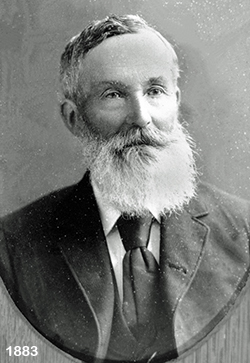 Gregory, Francis Thomas (Frank) (1821 - 1888)
Born on 19 October 1821 at Farnsfield, Nottinghamshire, England; died on 23 October 1888 at Toowoomba, Queensland.
He emigrated to Western Australia in 1829.
After getting a basic education, Gregory entered the Western Australian
public service in 1841 as a cadet surveyor.
In 1846, Gregory accompanied his older brother Augustus and explorer Henry
Churchman, to investigate the country north of Perth. The following year,
Gregory was appointed an assistant government surveyor; two years later he
was promoted to staff surveyor in 1849.
In 1857 he led expeditions to the upper Murchison River, and to country
farther east and north in 1858.
The next year Gregory visited England, to lobby the British government for
funding towards exploration of North-West Australia. Gregory believed that
the region might support grazing and/or plantation agriculture, based on the
use of indentured labour from Asia.
In 1860, the Government of Western Australia put Gregory in charge of a
proposed expedition to explore the interior around Nickol Bay. The
southwestern part of this region was later known as the Pilbara. The British
government provided £2,000 towards expenses.
As a result of the
expedition to Nickol Bay, Gregory was awarded the Gold Medal of the Royal Geographical Society (1863).
In 1862 Gregory moved to Queensland, where his brother Augustus was already prominent as an explorer and official.
In Queensland Francis Gregory was appointed as a Commissioner of Crown Lands.
He married Marion Hume in 1865.
From 1874, he was elected and served as a member of the Queensland
Legislative Council. For a short period during 1883, he served as the appointed Postmaster-General of Queensland.
Gregory died at Toowoomba on 23 October 1888 and was buried in Drayton and Toowoomba Cemetery.
Source: Extracted from:
https://en.wikipedia.org/wiki/Francis_Thomas_Gregory
Portrait Photo: 1883, Wikipedia.
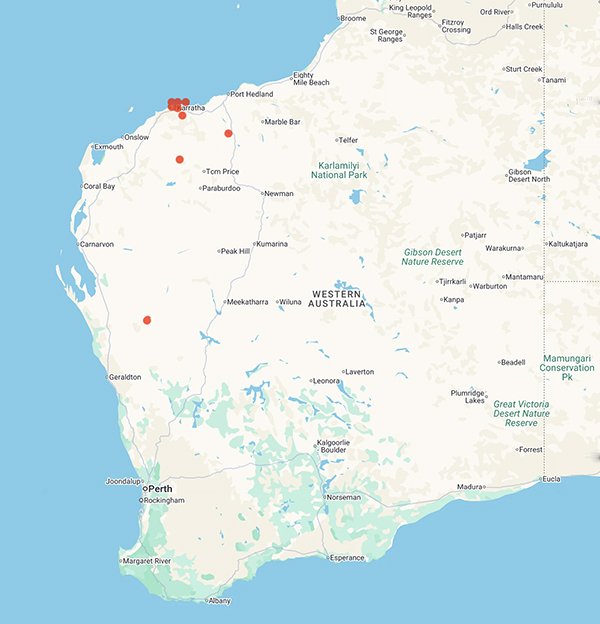
Data from 16 specimens